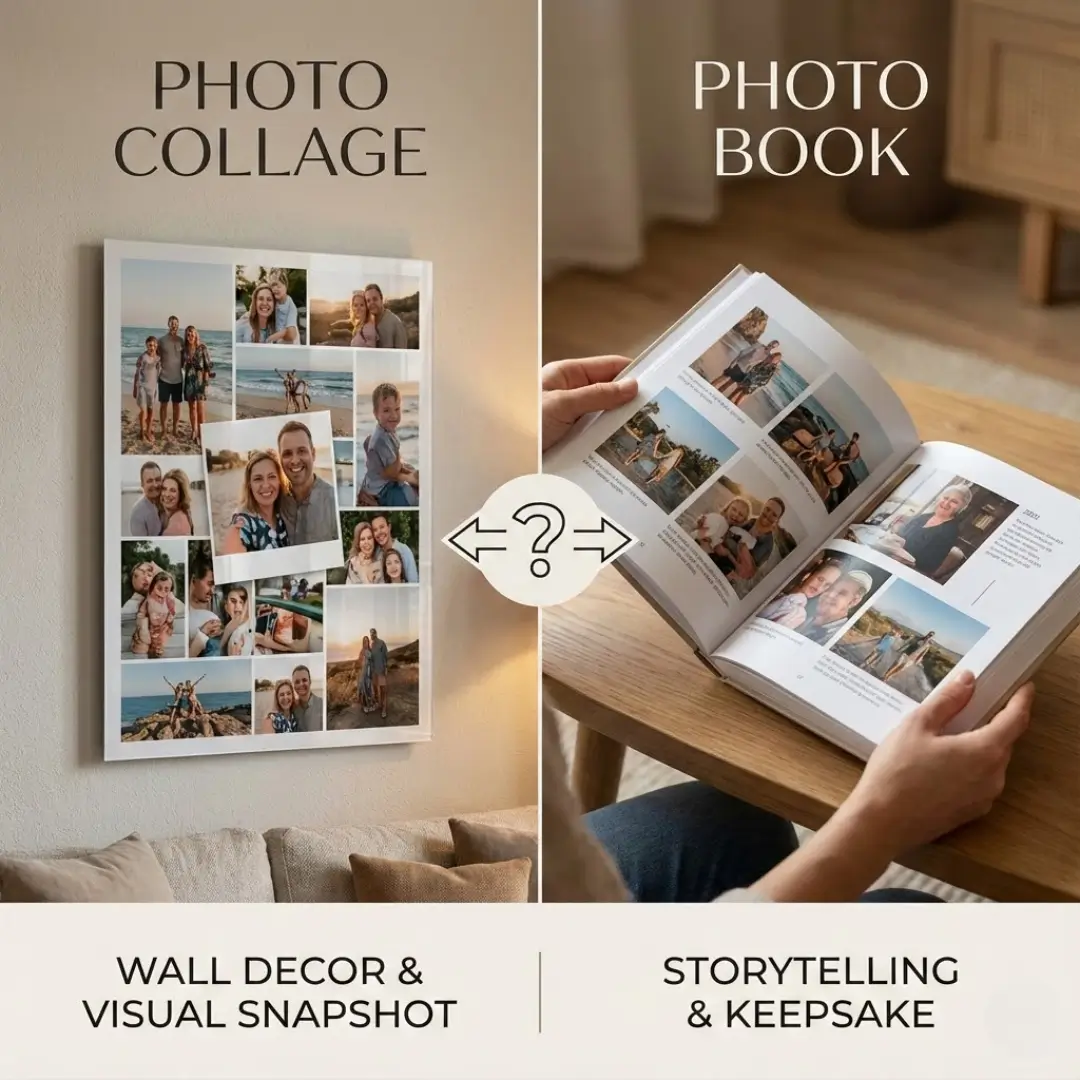
You have a camera roll full of cherished memories, from a recent vacation to your child’s first steps. Now comes the big question: what’s the best way to bring these digital moments into the physical world? You’re stuck deciding between two popular options.
Many people find themselves weighing the pros and cons of a photo collage vs photo book. One offers a single, artistic display, while the other tells a detailed story across multiple pages. This guide will walk you through the key differences to help you choose with confidence.
We’ll compare them based on storytelling potential, display value, cost, and the creation process. By the end, you’ll know exactly which format is the right fit for your specific needs and treasured photographs.
What is a Photo Collage?
A photo collage is a collection of multiple photos combined into a single image. This composite picture is then typically printed on a single surface, such as an acrylic print, canvas, or poster, designed to be displayed on a wall.
Collages are excellent for showcasing a theme or a collection of favorite moments at a glance. They act as a visual summary, highlighting the best parts of an event, a relationship, or a period in time. The focus is on immediate visual impact rather than a narrative sequence.
Key Characteristics of a Photo Collage:
- Single-Piece Display: All images are presented together on one panel.
- Visual Summary: Perfect for highlighting key moments rather than telling a long story.
- High Impact: Creates a dynamic piece of wall art that grabs attention.
- Versatile Design: Can be arranged in a structured grid or a more freestyle, overlapping layout.
Photo collages are often used for wall decor. You can explore creative photo collage ideas that go beyond simple grids to create a truly unique piece for your home.
What is a Photo Book?
A photo book is a professionally bound book that features your photos printed directly onto the pages, often with custom layouts, text, and embellishments. Think of it as a modern, high-quality version of a traditional photo album.
Photo books excel at storytelling. They allow you to arrange images chronologically or thematically across dozens of pages, guiding the viewer through a narrative. From a wedding day to a “year in review,” a photo book preserves a complete story from beginning to end.
Key Characteristics of a Photo Book:
- Narrative Format: Organizes photos sequentially to tell a comprehensive story.
- Detailed Storytelling: Provides space for captions, dates, and anecdotes to add context.
- Interactive Experience: Meant to be held, browsed, and enjoyed page by page.
- High Customization: Offers extensive options for covers, paper types, layouts, and themes.
The process involves carefully choosing photos for your photobook to build a cohesive and engaging narrative from start to finish.
Photo Collage vs Photo Book: A Head-to-Head Comparison
To help you decide, let’s compare these two formats across the factors that matter most.
| Feature | Photo Collage | Photo Book |
|---|---|---|
| Primary Use | Wall decor, single-glance display | Storytelling, detailed memory keeping |
| Storytelling | A visual “snapshot” of a theme or event | In-depth, chronological, or thematic narrative |
| Display Method | Hung on a wall as a focal art piece | Stored on a bookshelf or coffee table |
| Creation Effort | Generally quicker; focus on image arrangement | More involved; requires layout and story planning |
| Photo Capacity | Limited; typically 3-50 photos | High; can hold hundreds of photos |
1. Storytelling and Narrative
Photo Book: The clear winner for in-depth storytelling is the photo book. Its multi-page format is designed to take viewers on a journey. You can dedicate sections to different parts of an event, add text to explain moments, and build a narrative that unfolds over time. This makes it perfect for weddings, baby’s first year, or extensive travel albums.
Photo Collage: A photo collage tells a story in a single glance. It’s a highlight reel, not the full movie. It powerfully evokes the feeling of an event or the essence of a relationship without needing a chronological flow. A collage of your family laughing captures a feeling of joy instantly.
2. Display and Accessibility
Photo Collage: Collages are made for display. A large acrylic wall art collage can become a stunning focal point in a living room or hallway. It’s always visible, allowing you and your guests to enjoy the memories daily without any effort.
Photo Book: Photo books are more intimate. They are typically stored on a coffee table or bookshelf, ready to be picked up and explored. While they don’t serve as constant wall decor, they provide a cozy, interactive experience for family and friends to gather around and share stories.
3. Creation Process and Effort
Photo Collage: Creating a collage is often faster. You select your favorite photos and arrange them in a template using an online design tool. The primary decisions involve layout and which photos make the cut. Top free online photo collage makers can simplify this process significantly.
Photo Book: Designing a photo book requires more planning. You need to sequence your images, choose layouts for each page, write captions, and select cover and paper options. While modern AI-powered tools can help, it is a more involved project. However, this effort results in a deeply personal and comprehensive keepsake.
4. Cost and Value
Photo Collage: The cost of a collage depends on its size and material (e.g., canvas, acrylic, metal). A single large, high-quality collage might have a higher upfront cost than a basic photo book, but it doubles as home decor, adding tangible value to your living space.
Photo Book: A photo book’s price varies based on page count, cover type (hardcover vs. softcover), paper quality, and size. While a high-end book can be an investment, the cost per photo is often lower than a collage because it can hold so many images. Analyzing the full photobook cost can help you understand the long-term value.
When to Choose a Photo Collage
A photo collage is your best bet when:
- You want a single, impactful piece of wall art.
- You need to summarize an event or a theme with just a few key images.
- The goal is daily visibility and home decoration.
- You’re looking for a great gift that captures a shared feeling (e.g., friendship, family fun).
When to Choose a Photo Book
A photo book is the ideal choice when:
- You want to tell a detailed, chronological story.
- You have a large number of photos from an event (like a wedding or a long vacation).
- You want to include text, captions, or anecdotes alongside your photos.
- The goal is to create a personal keepsake that can be shared and revisited over time.
Conclusion: The Best Choice for Your Memories
The decision in the photo collage vs photo book debate comes down to your primary goal. Are you looking to create a piece of art that captures a feeling at a glance, or do you want to build a detailed story that preserves an entire event for years to come?
If your priority is a beautiful, always-visible display that summarizes your best moments, a photo collage is the perfect fit. If you aim to create a comprehensive narrative that you can hold in your hands and flip through, a photo book is the undeniable winner.
Ultimately, both are wonderful ways to honor your memories. Why not do both? Create a stunning family photo collage for your living room and design a detailed photo book of your last family vacation to keep on the coffee table.
Frequently Asked Questions (FAQ)
Q: Which is more expensive, a photo book or a photo collage?
A: It varies. A large, premium acrylic collage can be more expensive than a standard softcover photo book. However, a high-end, 100-page layflat photo book can cost more than a simple canvas collage. Your choice of materials, size, and page count are the biggest factors.
Q: How many photos can I use in a collage vs. a photo book?
A: A photo collage typically works best with 3 to 50 photos to avoid looking too cluttered. A photo book, on the other hand, can easily accommodate several hundred photos, allowing for a much more comprehensive collection.
Q: Is it easier to make a photo collage or a photo book?
A: A photo collage is generally quicker and easier to create. It involves selecting photos and arranging them on a single layout. A photo book requires more time for organizing photos chronologically, designing individual pages, and adding text.
Q: Which is better for a gift?
A: Both make excellent gifts. A photo collage is a great choice for a decorative gift that can be displayed immediately. A photo book is a more personal, intimate gift perfect for commemorating a shared experience like an anniversary or a trip.
Q: Can I tell a story with a photo collage?
A: Yes, but it’s a different kind of storytelling. A photo collage tells a story through a thematic or emotional snapshot—like capturing the joy of a birthday party in one image. It doesn’t show a sequence of events but rather the overall feeling.
Q: What materials are best for a photo collage?
A: Acrylic and canvas are the most popular choices for photo collages. Acrylic prints offer a modern, vibrant look, while canvas provides a more classic, textured feel. The best material depends on your home decor and personal style.
Q: How do I choose between a layflat photo book and a standard one?
A: Layflat photo books are ideal for showcasing panoramic shots across a two-page spread without a gutter interruption, offering a premium viewing experience. Standard books are more budget-friendly and perfectly suitable for most projects where seamless spreads are not essential.